As I am a fan of an index investing strategy and love a well-diversified portfolio exchange traded funds are the ideal solution.
What is an exchange traded fund (ETF)?
An ETF contains various assets such as stocks, bonds or commodities, and is traded on a stock exchange very much the same as a normal share. Investors can sell and buy the share during the trading day of the stock exchange.
Most of the ETFs are passively managed, which means they track an index, such as stock index or a bond index. This makes them quite attractive, as an investor who wishes to diversify can buy a part of the whole index instead of having to purchase individual shares. ETFs which track an index are also called index funds.
Most ETFs are index funds, but recently there have been some actively managed ETFs popping up. Actively managed ETFs are traded the same way as their passively managed counterparts, but they consist of various assets which are picked by a fund manager with certain investment objective.
In this blog I will not deal with actively managed ETFs, but stick to the traditional (and in my opinion more attractive) traditional index funds. As commodities are a field with many traps and difficulties (again my opinion) I will focus on two main classes:
Bond index ETFs and Stock Index ETFs
Did you do your asset allocation test as outlined in the first article of this blog “How to get started investing in Singapore?”?
A good investment strategy starts with a solid asset allocation. In my case it looks like this:
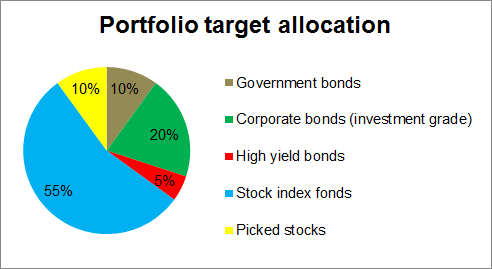
If you head over to my portfolio you will see that I am an absolute idiot when it comes to picking stocks and that I am still in transition to my target asset allocation. Thankfully I am not alone in this predicament, as history has shown that nobody ever managed to outperform the market index for ten years or more.
Thus I decided to go the easy route: just buy the market as a whole in low cost index fund. Some index funds for stocks and some index funds for bonds and I should be set.
As I am weak and picking stocks is too much fun I decided to give myself some play money and allow 10% of my portfolio to go into picked stocks. Not a financially sound decision, but surely a fun one.
The same is true for high yield bonds, which I allow to make up 5% of my portfolio as an experiment.
Exchange traded funds available in Singapore
Singaporean investors have a growing range of ETFs to choose from on our home stock exchange SGX.
There are stock index funds and bond index funds available tracking various indexes.
Selected index funds available in Singapore
Last updated on May 19, 2014
| Name of the exchangetraded fund | Class | Currency | SGX ticker | Bloomberg ticker | Expense Ratio (%) | What are you buying? | Distri-butions? | Website |
|---|---|---|---|---|---|---|---|---|
| SPDR® Straits Times ETF | Equity | SGD | ES3 | STTF:SP | 0.30 | The Straits Times Index | twice per year | link |
| iShares Barclays Asia Local Currency 1-3 Year Bond Index ETF | Bonds | SGD / USD | SGD=QL0 USD=O9Q | SGD=ASHYS:SP USD=ASHYS:SP | 0.35 | The Barclays Asia Local Currency short duration bond index, which in USD terms tracks corporate short term local currency bonds in Asia Pacific. | 4 times per year | link |
| iShares Barclays USD Asia High Yield Bond Index ETF | Junk Bonds | SGD / USD | SGD=QL3 USD=O9P | SGD=ASHYS:SP USD=AHYG:SP | 0.50 | The Barclays Asia USD High Yield Diversified Credit Index of below investment grade bonds (Junk Bonds) | 4 times per year | link |
| iShares J.P. Morgan USD Asia Credit Bond Index ETF | Bonds | SGD / USD | SGD=QL2 USD=N6M | SGD=AJACS:SP USD=AJAC:SP | 0.30 | The J.P. Morgan Asia Credit Index which tracks a range of dollar denominated corporate and government debts issued in Asia (excluding Japan) | 4 times per year | link |
| Nikko AM Singapore STI ETF | Equity | SGD | G3B | DBSSTI:SP | 0.20 | The Straits Times Index | twice per year | link |
| ABF Singapore Bond Index Fund | Bonds | SGD | A35 | SBIF:SP | 0.15 | High-quality bonds issued by the Singapore government and government-linked bodies | Once per year | link |
| CIMB FTSE ASEAN 40 | Equity | SGD / USD | SGD=QS0 USD=M62 | SGD=ASEANS:SP USD=ASEAN:SP | 0.65 | Top 40 securities (by market capitalization) in Singapore, Malaysia, Indonesia, Thailand & Philippines. | Once per year | link |
| CIMB S&P Ethical Asia Pacific Dividend ETF | Equity | SGD / USD | SGD=QR9 USD=P5P | SGD=CIMBDVDS:SP USD=CIMBDVD:SP | 0.65 | S&P Ethical Pan Asia Select Dividend Opportunities Index of the 40 highest dividend yielding stocks with <5% revenue from alcohol, gaming, pork & tobacco. | Once per year | link |
How to read this table:
- Name: This is the name of the index fond given to it by the managing company.
- Class: Either bonds (fixed income) or equity (stocks).
- SGX ticker: the symbol it is using on our Singapore Stock Exchange (SGX). You will need this to buy the stock via your broker.
- Bloomberg ticker: Included here for your convenience in case you would like to get information about the fund on bloomberg.com
- Distributions: some index funds pay dividends in certain intervals. This dividend is then credited in cash to your settlement account. Other index funds automatically re-invest those dividends for you.
- Expense ratio: this is the cost you are paying the index fund company for managing the fund. This is often abbreviated as TER (total expense ratio). Expense ratio matters! For example investing SGD 10,000 in a fund with 0.38% will cost you SGD 38 per year. Investing the same in a fund with a expense ratio of 0.8% would mean paying SGD 80. Obviously this expense ratio is built into the performance of the fund, so you are indirectly and not directly charged for it.
This table is only a selection, you can find all ETFs traded in Singapore by using the official ETF screener on SGX (http://203.127.29.74/wps/portal/sgxweb/home/products/securities/etfs/etf_screener)
Read on:
Really helpful information here.
I would like to diversify and get exposure to the US market. The Vanguard S&P500 is on my list. However I understand dividends are tax at 30%. Could you shed some light on capital gains?
JW
Hi JW, capital gains would not be taxed. I would recommend you buy a Singapore listed low cost ETF tracking the S&P500 instead. How about this one:
http://www.spdrs.com.sg/etf/fund/fund_detail_SPY.html
Singapore listed ETF like the one you mentioned (S27) are extremely illiquid, just look at the volume, it’s really low! Is that something to be concerned about, low volume?
If you are buying to hold long term (which quite likely is the right thing to do) then the low liquidity should not be a huge issue as you will not be in a hurry to sell or buy. You could also buy in Hong Kong of course if there is a more liquid fund there. Good luck 🙂
Hi,
the S27 is USA domiciled even though it is listed in Singapore stock exchange. Isn’t it also subjected to withholding tax as well as estate tax?
Dave
The annual report for S27 states: “Dividend income and
capital gain distributions, if any, are recognized daily on the ex-dividend date, net of any foreign taxes withheld at
source, if any.”
My guess is that you would be charged the withholding tax indirectly (i.e. the fund will pay and then just distribute any dividends with the tax already deducted). I am not 100% sure and am no expert on withholding tax. You should have a look at the annual report linked at: http://www.spdrs.com.sg/etf/fund/fund_detail_SPY.html
Is there a method to estimate the “fair value” of these ETFS?
Thank You.
This depends very much how the “fair value” of one of these ETFs is defined. Normally the price the ETFs are traded should be as close as possible to the value of the underlying securities. This is called NAV (Net asset value). The closer the ETFs price is to the NAV the better.
The NAV and the price of the ETFs are depended on the underlying index. It is very hard to judge the fair value of a whole market, e.g. all of Asia Pacific’s high dividend stocks excluding Japan. My strategy is rather to evenly invest each month and hold for 10 years or more. Like this I do not have to worry about the ups and downs of the market so much.
Thank you for your explanation & response. I posed this question to a professional trader, and he said its difficult, as the ETF companies “control” the key.
Hi,
I am actually looking into buying the S27 index. Do you have any idea if there is any min quantities in getting them?
Thanks
Hi alex, do you mean the SPDR® S&P 500?
If yes you can find the info here: http://www.spdrs.com.sg/etf/fund/fund_detail_SPY.html#
Board lot size is 10, so minimum order is about 10 x USD 195 = USD 1,955
Yes i am refering to SPDR@ S&P 500. I am just confused with the board lot size, was wondering if its (10 LOT) or the other way round. Thanks for response.
Alex
What’s the minimum amount u need to put into stand chartered account to start using their trading account?
As far as I know there is no minimum amount.
Hi bro, thanks for the information, which is useful.
I myself is a passive investor and I hold quite some ETFs. Roughly half in US, half in HK/China, and a little bit in SG.
Currently I am paying the 30% US withholding tax, which I hate but can’t avoid.
So our conclusion is there is no way to have US exposure without the 30% tax? even in SG or HK?
Also I don’t like SG ETFs due to the terrible liquidity.
Yes you are right, unfortunately there is no way to get US exposure without the terrible 30% tax… You are right about the ETFs listed in SG, liquidity is a concern. People in Hong Kong have it easier in this regard!
Hello, I’m bummed just learning about the 30% tax on dividends from US stock/ETFs..
Can you elaborate on the liquidity concern of SG ETF? How is it different from US and what should I be concerned?
Hi
I am holding UETFSSE50. I relooked at their account recently.
And was shock that the expense ratio is 2.74%.
(http://www.uobam.com.sg/uobam/assets/pdfs/prospectus/sse50_etf.pdf) Under “17.2 Expense ratio” Page 41
I thought i may be overpaying as i understand most ETF have expense ratio under 1%. Can you confirm i am not missing something? Thank you.
Hi Roy,
this is quite confusing, as the fact sheet mentions 0.45% management fee (http://www.uobam.com.sg/uobam/assets/pdfs/fundfact/FundReviewUSSE50ChinaETF.pdf). I would recommend contacting UOB directly via phone and asking them about the expenses for this particular ETF. Once you find out please post again here, I would be very curious to know this as well.
Hi
I am following up with UOBAM and will get back when they replied.
It seems that total expense ratio is total cost which management fees is a subset of total expense ratio.
Even if it is so, i still think TER at 2.74% is too high relative to industry standard.
I am looking for exposure to China, are you familiar with any other active ETF that has reasonable liquidity?
As i say, i will keep you posted when i received any reply from UOBAM.
Thanks Roy, am really interesting what you will find! HD8 might be an alternative in Singapore (TER 0.6%) but I am not sure if this is what you are looking for. You might find better choices on the HK exchange.
Hi
Finally, after a few rounds of communication with UOBAssetManagement sales, they confirmed 2.74% is the TER.
And the reason it has a higher TER because of the fund structure that include market assess, counterparty cost, bid-spread etc…..
BTW, what do you mean HD8?
2.74% wow, these expenses are indeed crazily high! With HD8 I meant this: https://sg.finance.yahoo.com/q?s=HD8.SI
Might be a better alternative…
Hi there,
May I know how do you buy ETFs listed in Hong Kong? Any recommendations for brokerages?
It is up to you! I personally like Standard Chartered as they do not charge for receiving the dividends. Standard Chartered also does not seem to have any monthly fee per counter that some other banks are charging.
Most of the banks publish the fees online, so it is good to do some research/comparison first. It is very important to find out the detailed charges for the handling of HK dividends, since some banks charge a lot for that. This seems especially the case for OCBC – I was very surprised when a friend of mine told me how much she had to pay to receive the dividends!