I made it!
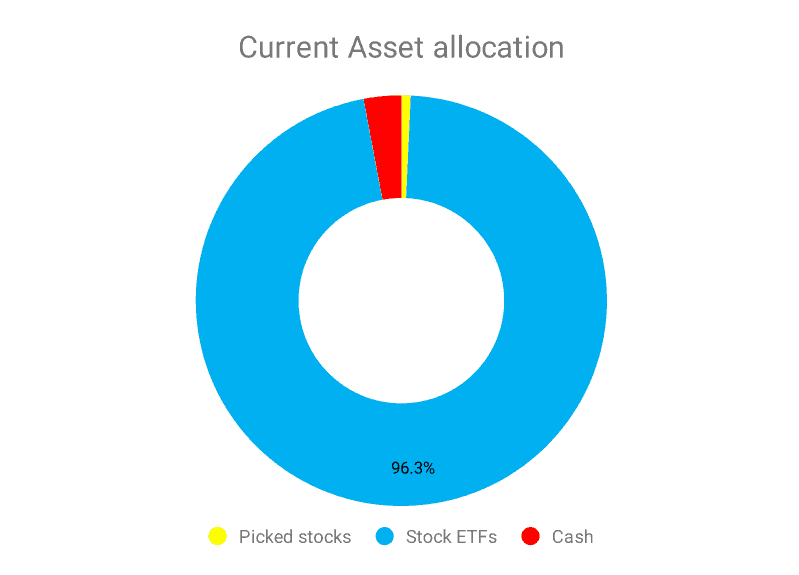
In the first half of 2026, my portfolio increased by SGD 186,929, from SGD 1,289,370 to SGD 1,476,299.
Of this increase, SGD 178,080 came from capital gains, SGD 6,715 from fresh investments, and SGD 2,134 from reinvested dividends.
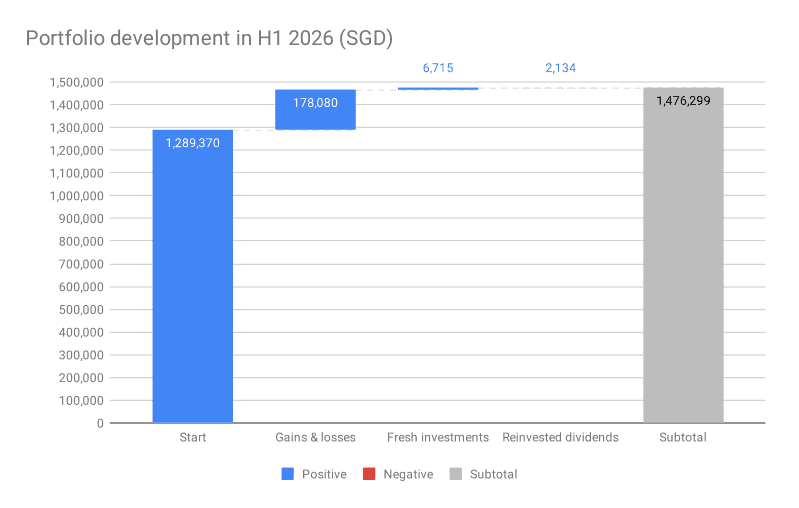
That kind of gain is pretty insane, especially since my current net salary is only around SGD 74,555 per year. At this portfolio size, market movements are beginning to dwarf my salary.
For now, those movements are working in my favor. Sooner or later, the same volatility will inevitably work against me as well.
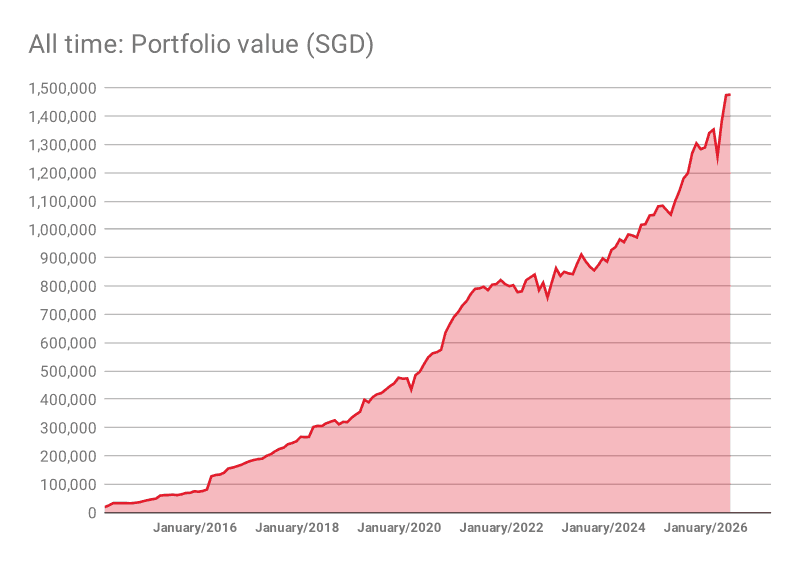
Because I am tax-resident in Germany, I currently cannot rebalance my asset allocation. The current allocation is:
My Expenses in the First Half of 2026
In the first half of the year, I spent SGD 30,165, equivalent to an average of approximately SGD 5,028 per month.
That was a lot. I spent more on wants than on needs. My largest spending categories were:
- Travel: SGD 5,908 – 19.6% of total spending
- Accommodation: SGD 5,590 – 18.5%
- Groceries: SGD 3,774 – 12.5%
- Eating out: SGD 3,031 – 10.0%
- Work-related expenses: SGD 1,806 – 6.0%
- Clothes: SGD 1,123 – 3.7%
- Everything else: SGD 8,933 – 29.6%
The “work-related expenses” category is interesting because most of this spending would disappear if I quit my job. It includes dry cleaning for work clothes, work-related meals with coworkers, and various other job-related costs.
Most of my eating-out spending occurred in Spain and France. I hardly ever eat out in Switzerland.
I bought so many clothes, what was I thinking?
It is obvious that I could reduce my spending by more than 30% with a bit of optimizations once I stop working.
Even with this rather wasteful level of spending, however – drumroll…
I declare myself financially independent
Over twelve years ago, in June 2014, I published my first finance update on this blog.
Now it has finally happened:
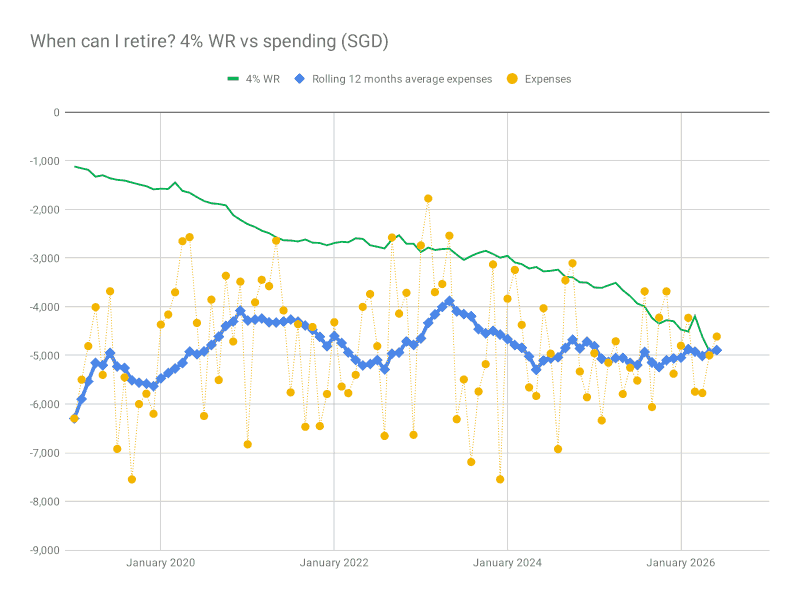
My hypothetical retirement income at a 4% withdrawal rate – the green line – now covers my trailing 12-month average expenses, represented by the blue line.
As of 30 June 2026, my trailing 12-month spending was equivalent to approximately 3.9% of my portfolio.
If I had not done 2 startup investments (details below), not quit my cushy job at age 40 and not spent that much money, I would have been done 2–3 years earlier. But like this the journey was a bit more fun.
Work is officially optional now, hooray!
But wait, is a 4% SWR really a “safe” withdrawal rate?
Sg Finance Blogger Legend Kyith has written an interesting comment below my last post, which I find quite insightful.
He also mentioned his Gilgamesh Tool which can nicely calculate how various portfolios and SWR would have fared. Highly recommended!
I believe at the end of the day, it depends on personal risk tolerance. I have some potential upsides explained below, plus it is quite unlikely that I would never earn any money again. Should inflation be super bad or there would be an economic crisis I would probably save some money and spend a bit less etc. Like Kyith pointed out, it is good if the basics are covered no matter what. My spending is mostly on wants vs needs. My basic needs can easily be covered at 2.5% WR of current portfolio in case of any unforeseen disaster.
In my personal risk tolerance 4% WR is very safe, 3.65% WR extremely safe and anything below 3.2% would mean leaving a huge inheritance to my non-existing kids.
Before retiring, I would probably also keep at least 1-2 year’s of cash buffer to protect against sequence-of-return risk. I have some cash funds not counted as part of the portfolio, that could be used.
Most people in the Financial Independence world seem to gravitate to ever lower SWRs the bigger their portfolios become. I can understand, as chasing financial independence encourages a lot of planning and calculating. It is tempting to minimize the risks further and further.
In my opinion, this ignores the fact that life is short and inherently quite risky. Even people with a healthy lifestyle get sick or die, we might make the wrong choices in love & life, I know a lot of messed up rich people. Instead of optimizing the SWR even further, I would probably try my best to reduce the other risks and optimize life in other areas – payoff seems higher.
The New Plan
When will I completely stop working and retire? It now depends mainly on two things: my wife’s job and my startup job.
My wife’s job
My wife still wants to work in Switzerland for a while because the money is excellent.
During the first six months of the year, she invested SGD 116,306 in her portfolio and put SGD 10,438+ into tax-deferred pension investments. On top of that, she continues to build her entitlement to a Swiss pension.
She is considering working for another one or two years, or perhaps trying to secure one of those cushy expat assignments.
An expat assignment with her current company would be the jackpot: an extremely high salary, plenty of perks, and a new adventure. At the same time, she hates her current job but loves the benefits that come with it.
Her portfolio is now worth approximately SGD 894,660. Our combined portfolios therefore total around SGD 2.37 million, which could provide roughly SGD 94,800 per year at a 4% withdrawal rate.
That would be more than enough for us.
My startup job
This autumn, all of my current shares will have vested.
We are also working on the company’s next funding round. If the round closes, I will need to negotiate both additional shares and a significantly higher salary.
I am considering asking for my gross salary to increase from SGD 126,744 to SGD 178,932, together with another allocation of shares.
The gross salary sounds nicer than it is, as more than half will go to taxes.
If the startup refuses or makes a lowball offer, I can switch to freelance work or simply quit.
I will probably retire for good when any of the following things happens:
- the startup makes an unattractive offer,
- my wife decides to stop working,
- we decide to move abroad,
- or I get pissed off at working for any mundane reason.
In the meantime, I will continue working a little longer. My motivation is already rather low, and thanks to AI and other optimizations, I work for only one or two hours on many days. This week my only meetings were my Spanish class and some meetings that were actually interesting. Big difference to corporate.
Potential Upsides
These are the upsides that are not counted in my FI(RE) plan, but could materialize:
1) Shares in my startup employer
After five years, things are looking solid. A strong exit is a real possibility and represents the largest potential upside. I would roughly estimate the probability at 1 in 20. Those are not terrible odds.
2) My state-pension entitlement
I should receive a small state pension beginning at age 67 or 68.
In today’s money, I can look forward to the “generous sum” of approximately SGD 373–SGD 432 per month.
3) My startup investments
I own approximately 0.5% of one startup and 19.7% of another.
Both are doing reasonably well and could eventually provide additional upside through an exit or dividend payments. I guess the odds are about 1:10.
4) Unemployment benefit
I would be entitled to generous German unemployment pay for 9-12 months after retiring. I am currently not planning to claim this benefit to save poor Germany some cost and because I personally do not find it ethical somehow. Should the stock market tank completely during the first 2 years of retirement, I could of course still change my mind…
congratulations on your achievement!!